Monday, September 21, 2009

In Somalia, WFP Spins As It Hires Mercenaries, Sources Say, of Fig Leaves and Famine and Blackwater / Xe Training the TFG

By Matthew Russell Lee

@ InnercityPress.Com

UNITED NATIONS, September 20 -- The UN World Food Program's activities in Somalia, portrayed critically last week by the Wall Street Journal and defended by the BBC, bear a closer look. The Wall Street Journal ran a belated story on U.S. and UK concerns that some of their funding of WFP is running off to the Al Shabaab rebels. Inner City Pressfollowed up, asking top UN humanitarian John Holmes about the allegations. Holmes, like the BBC, pinned them on the U.S., not his native UK. Video here, from Minute 28:26.

The BBC ran a piece saying that U.S. sanctions are leading to starving children in zones that are rebel controlled. Inner City Press' Somali sources, too, say that the U.S. and UK are playing the politics of food, trying to starve out those who live in Shabaab controlled areas. They wonder why the UN's Ban Ki-moon has said nothing about this.

But now sources tell Inner City Press that the World Food Program, in part to counter U.S. concerns and also to serve U.S. policy, has hired mercenaries, "Blackwater" it is said. The sources go further, saying that the stated size of WFP's program in Somalia cannot be verified with real food purchases, that some portion is just cover for funding mercenaries' training of militias supportive of the Transitional Federal Government.

These sources say this is not the first financial shenanigans by WFP, that much of WFP's appeal for funding is to cover a "black hole" in WFP's past budget, money borrowed in expectation of pledges.


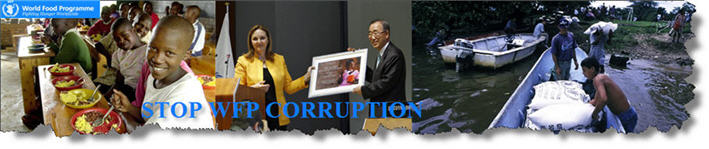
UN's Ban and WFP's Sheeran on the move, mercenaries and politics of food not shown

Meanwhile, as Inner City Press has reported, WFP chief Josette Sheeran spend some $400,000 dollars to have children from Ghana flown in for a "simulated feeding program" for the spouses of G-8 leaders at the meeting in Italy. Click herefor that.

Clearly, Josette can get her message out through BBC. But why wasn't she included, as UNICEF's Ann Veneman was, in Forbes' list of most powerful women? Watch this site.

Thursday, September 17, 2009

Most vulnerable must not be forgotten, says chief of UN anti-hunger agency

UN NEWS CENTRE

http://www.un.org/apps/news/story.asp?NewsID=32078&Cr=hung&Cr1=

16 September 2009 – With the global economy beginning to show signs of turning the corner, the head of the United Nations World Food Programme (WFP) today issued an urgent plea to ensure that those hardest hit by the financial crisis – considered by many to have started one year ago this week – are not forgotten.

There are more hungry people in the world and less food aid than ever before, with the number of the world’s hungry to surpass 1 billion this year while the flow of food aid is at its lowest in two decades.

“For the world’s most vulnerable, the perfect storm is hitting with a vengeance,” WFP Executive Director Josette Sheeran said in a statement issued in London.

onors have been extremely generous, but the fact is that the cost of food is still high, needs have gone up

So far, the agency has received less than half of the $6.7 billion it needs to feed 108 million people in 74 countries, she noted. At current funding levels, WFP will be forced to cut back its life-saving activities to feed the hungry in places such as Kenya, Bangladesh and Somalia.

“Donors have been extremely generous, but the fact is that the cost of food is still high, needs have gone up and this requires the world to step to the place in a bigger way,” Ms. Sheeran said.

People in the United States and Europe are increasingly relying on government safety nets for food, she pointed out, but 80 per cent of the world does not have this luxury.

“We urgently need an additional $3 billion to meet those needs, which is less than 0.01 per cent of what was put on the table to stabilize the world financially.”

Food Aid Hits 20-Year Low As Number Of 'Critically Hungry' People Increases, WFP Says

Kaiser Foundation

http://globalhealth.kff.org/Daily-Reports/2009/September/17/GH-091709-Food-Aid.aspx

Global food aid is at a 20-year low even though the number of "critically hungry people" is expected to reach the highest level ever, the U.N. World Food Programme (WFP) said on Wednesday, Reuters reports (9/16).

At a press conference, Josette Sheeran, executive director of WFP, said that for the first time in history, the number of hungry people would rise to 1.02 billion this year, according to data from the U.N. Food and Agriculture Organization. WFP is facing a significant budget shortfall, Sheeran said, as it seeks to feed 108 million people in 2009, Bernama reports, adding that the "shortage means ration reductions and cuts in programs that provide a lifeline to the world's hungriest people" (9/17).

"WFP says it needs $6.67 billion in funds to help people around the world cope with rising food prices, droughts and conflicts, but it has only received $2.6 billion so far," Al Jazeera writes in an article that includes a video interview with Sheeran about the global hunger crisis (Serra, 9/16).

In a press release, Sheeran said, "The double whammy of the financial crisis and the still record high food prices around the world is delivering a devastating blow. Throw in a storm, a drought and a conflict and you have a recipe for disaster." She said the additional $3 billion needed represents "less than 0.01 percent of what was put on the table to stabilise the world financially." At current funding levels, WFP will have to cut services in October, she said, citing Bangladesh, Kenya and Somalia as examples of where programs would have to be scaled back (9/16).

Several other media outlets reported on stories related to food security, hunger and malnutrition:

  • Xinhua/People's Daily Online: "FAO: Hunger combat in L. America goes back" (9/17).
  • Reuters: "Powerhouse India lags China in nutrition goals" (Bhalla, 9/16).
  • BBC: "US curbs 'behind WFP Somali cuts'" (Plaut, 9/16).

WFP purchased 142,586 metre tonnes of food locally in Pakistan

Associated Press of Pakistan

http://www.app.com.pk/en_/index.php?option=com_content&task=view&id=86146&Itemid=2

LONDON, Sept 17 (APP): The UN food agency has since the start of the current year made a purchase of 142,586 metric tonnes of food commodities locally in Pakistan worth nearly US $ 50,000 to deal with the displacement of people from Swat and Malakand region and their subsequent rehabilitation.

According to information provided to APP by the World Food Programme in context to a question raised at Wednesday’s press briefing by the WFP Executive Director Josette Sheeran, the organisation said the total value of commodities purchased from Pakistani farmers mounted to US $ 49,681,023.

The commodities included pea wheat blend, high energy biscuits, salt, pulses, sugar, tea, and wheat.

At the briefing, the WFP official raised concerns over lack of funding for the organisation to feed the hungry around the globe.

“The WFP is facing a serious budget shortfall with barely one third of the funding it needs to feed 108 million people this year. The number of hungry people will pass 1 billion this year for the first time in history but the flow of food aid is at a twenty year low.”

Sheeran also pointed out that WFP needs an extra US $ 3 billion to bridge the gap in its budget this year while confirmed WFP funds till September stood at US $ 2.6 billion.

She appealed to the UN General Assembly and the G20 leaders attending their forthcoming summit to put hunger on the map.

According to WFP Director, Kenya, Guatemala, Bangladesh, Chad and Somalia face ration reduction and cuts in programmes to feed poor and hungry.

Wednesday, September 16, 2009

US curbs 'behind WFP Somali cuts'

By Martin Plaut
BBC News

The World Food Programme says US curbs are in part behind its move to shut its Somali feeding programmes for more than 100,000 acutely malnourished children.

The US restrictions affect funding for areas controlled by groups designated as terrorist.

Washington has imposed sanctions on the hardline Somali Islamist group, al-Shabab.

But the WFP says it is doing all it can to get the aid through without it being controlled by the Somali insurgents.

Drought and war has left 109,000 children-under-five acutely dependent on the feeding centres run by the WFP.

We take all precautions to ensure that our food only goes to the most needy
Josette Sheeran

But money has run out. The centres are closing, to focus the remaining resources on the most needy - babies under two years old, who would never recover from acute malnutrition.

Aid workers have told the BBC the cuts are the result of a freeze on funding by the United States Office of Foreign Disaster Assistance.

Josette Sheeran, executive director of the WFP, said she was unaware of a ban.

She continued: "We've heard of needing to deal with the particular restrictions they have on where aid goes and needing to look at whether or not we can work in compliance with those restrictions."

The US embargo is stopping American aid funds from reaching the vast areas of southern and central Somalia, where the UN estimates half the population is now in need of food aid.

Ms Sheeran said that "getting help to them inevitably involves dealing with al-Shabab and other hardline groups now in control of the towns and villages across the region".

"We take all precautions to ensure that our food only goes to the most needy and is not handled by any particular political groups in Somalia or elsewhere and in particular al-Shabab in Somalia," she said.

"We hope to work through these difficulties and challenges.

"Right now in Somalia, WFP has by far the biggest programme and there are very few aid groups left functioning there."

Ms Sheeran says the WFP is working with the administration of US President Barack Obama on an almost weekly basis to try to resolve these difficulties.

In the meantime the children of Somalia are going without the food they so badly need.

UN Aid Diversion in Somalia Portrayed as Inevitable, Murky Investigation by WFP

By Matthew Russell Lee

UNITED NATIONS, September 16 -- Amid allegations that UN aid funds are being diverted in Somalia, leading to reported threats by the United Kingdom and U.S. to cut or condition their funding, Inner City Press on Wednesday asked top UN humanitarian John Holmes what the UN is doing.

Holmes said that the World Food Program has begun an internal investigation, and that he doesn't know how long it will take. He said it is mostly the U.S. that is concerned -- others name the UK first -- and that other donors just keep on giving. He said there is little choice but to continue. Videohere, from Minute 28:26.

Since the allegations focus on particular trucking companies that are being used, and their links to entities on anti-terrorism lists, Inner City Press asked Holmes what is being done about this, since such diversion would violate, in some cases, legal prohibitions. Holmes said that WFP is diversifying the number of trucking firms it works with. He did not address the legal question. (As reported earlier today, the UN's top legal refuses to answer questions other than on the narrow topics for which she appears for press conferences: today, the UN Treaty Event).

In a sense, there is not a contradiction between taking seriously and acting on these allegations of diversion of funds, and wanting the programs to continue. In fact, diversion leads to a lack of credibility, and ultimately hurts the programs' beneficiaries more.


UN's Ban gets award from WFP's Sheeran, diversion of UN aid in Somalia not shown

Merely referring problems to internal investigations, the time frame of which knows no limits, also hurts the UN's credibility, as has happened this summer in the months old investigation of the head of the UN's Congo Mission Alan Doss asking the UN Development Program for "leeway" to hire his daughter. It was relegated to an internal investigation, and nothing has been done. Watch this site.

Footnote: when during the summer's G-8 meeting WFP spent $400,000 to fly in children from Ghana for a "simulated feeding demonstration" for the G-8 leaders' spouses, neither Ban Ki-moon nor John Holmes for OCHA said there was anything wrong with this. This too undermines confidence in the UN, including by donors.


U.N. Probes if Somali Contractors Are Diverting Aid, Funding Rebels

NAIROBI, Kenya -- A United Nations group is investigating whether three Somali contractors it uses to ship food aid to people in the war-ravaged country are misappropriating aid and providing financial assistance to insurgent groups, according to U.N. officials.

The U.N. Monitoring Group on Somalia opened its probe in July, the officials said. The U.N. World Food Program said it is also investigating allegations regarding diversion of food assistance in the country.

A February U.N. internal report, written by U.N. officials and approved by several of its agencies, including the WFP, said the food-distribution system in Somalia posed "considerable risk to the reputation and effectiveness of the organization," according to a copy reviewed by The Wall Street Journal. The WFP declined to comment on the report.

The WFP says its operation in Somalia, one of the agency's largest, reaches 3.5 million people. Officials from the U.N., African Union and Somali government say they are increasingly concerned about the dependability of some of the contractors used by the WFP, which handed out $35 million in food-aid distribution contracts in Somalia last year. It now uses 29 contractors.

The U.K. says it is considering withdrawing financial support for the Somalia program because of concerns about food distribution; the U.S. has also threatened to do so, according to a U.N. official close to the situation and a Western diplomat with knowledge of the donors' concerns.

British officials said they are waiting for the outcome of the WFP's investigation before deciding whether to suspend funding.

USAID, the U.S. agency that gives international humanitarian assistance, is the biggest provider of funding to the WFP's Somalia program. A U.S. official said the government "has been reviewing our policies and procedures for the provision of humanitarian assistance in Somalia," including ensuring that the donations comply with U.S. antiterrorism laws.

The U.S. has given more than $124 million in food aid for Somalia so far in the 2009 fiscal year, according to the U.S. official.

Peter Smerdon, a spokesman for the WFP in Nairobi, said the WFP inspector-general's office, which is separate from the Monitoring Group on Somalia, is investigating allegations regarding diversion of food assistance.

Denise Brown, the WFP's deputy country director for Somalia, said she wasn't aware of the Monitoring Group's probe and therefore couldn't comment on it. "We are, I think, quite happy, or satisfied, with the current system we are using," she said.

According to U.N. officials, investigators from the U.N. Monitoring Group on Somalia are looking at Abukar Adani, a Somali businessman, along with some family members and a network of companies they control. Investigators are also looking at Abdulkadir Eno, a Somali-American businessman with interests in Somali ports, and Somali businessman Mohamed Deylaf, these officials said. All three deny misappropriating food aid.

Mr. Adani's son, Abdulkadir Abukar Omar Adani, the managing partner of the family's main trading company, Swift Traders East Africa Co., said the Adani family supports the current government. But he said that to transport food in the country his company is sometimes forced to do business with groups such as al Shabab, the main Islamist insurgency group, which is battling the government and controls much of southern Somalia.

Mr. Adani said representatives from his company negotiate with these groups and sometimes are required to pay them. "Sometimes they impose on you," he said. Payments are part of doing business, and shouldn't be interpreted as a sign of support for the rebel group, he said. "We are not involved in any politics," he said.

Mr. Deylaf said he hasn't provided support to insurgents and supports the government.

Mr. Eno also denied supporting insurgent groups and said he has a financial interest in backing the government, which controls just a portion of the capital, Mogadishu. "Our company believes that once peace and stability are attained in Somalia, then our business activities would be sustainable," he said.