Showing posts with label barack obama. Show all posts

Tuesday, January 3, 2012

End of ignorance era at WFP ! - Sheeran shown the door despite heavy "lobbying in Washington DC"

Losing WFP Fight, Sheeran Sets Sail for WEF, Cousin Fix In UN System Fog?

By Matthew Russell Lee

UNITED NATIONS, January 3 -- This morning Josette Sheeran, the head of the World Food Program who didn't want to leave, announced that when her term ends in April she will become the deputy at the World Economic Forum.

As Inner City Press reported in early November, Sheeran was enlisting Republican members of the US Congress to threat to cut funding to WFP if she did not get a second term.

But Barack Obama had in mind a former Chicago public relations executive Ertharin Cousin. Conveniently, Cousin has been serving as US Ambassador to the UN Food and Agriculture Organization, whose director along with Secretary General Ban Ki-moon nominates the head of WFP. So it would seem the fix is in.

Back in July 2009, as Inner City Press exclusively reported,

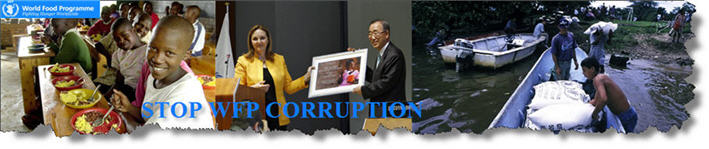
"UNITED NATIONS, July 11 -- On the sidelines of the G-8 meeting on July 10, the World Food Program shut down its headquarters for a "simulated food distribution" for the spouses of the G-8 leaders, flying in school children from Ghana to put them on display. Many WFP staff members found the display disgusting, a waste of money and a disrespect to UN recipients. U.S. First Lady Michelle Obama may have shared some of the concerns: she did not attend... Sheeran, rumored to be under review by the the U.S. which nominated her under George Bush, conducted a 'seminar' which some attendees found awkward and stilted, 'a quest for personal publicity.'"

There was also some less public jockeying: again as Inner City Press exclusively reported, within the UN system community in Rome, many alleged Sheeran engaged in a quid pro quo with then FAO chief Jacques Diouf, hiring a relative of his for an information technology post in exchange for FAO hiring the husband of her personal assistant, Tanujah Rastogi.

(Cousin, we note in passing, once served as Deputy Director of the Chicago Ethics Board.)

One thing Sheeran can be credited with during most of here WFP tenure is not shying from questions, in marked contrast to most other UN system executive in Ban Ki-moon five years.

(c) UN Photo
Ban gives Sheeran a picture: (Chicago) boot not shown

Footnote: Sheeran's announcement was re-tweeted by the head of the UN Development Program Helen Clark, who like Ban's chief lawyer Patricia O'Brien has refused multiple requests to take questions in New York, the headquarters of UNDP.

So here's a question for UNDP: does the agency deny, or why has it covered it, that the Sudanese National Security Committee has barred it from entering Al Muglad in South Kordofan, including having vehicles detained by military intelligence for days in Babanusa and being barred from passing to El Obeid in North Kordofan? There are of course other questions. Watch this site.

Monday, November 14, 2011

Delay, but likely business as usual, in WFP appointment

Click here to view this at Global Memo

Some months back, I spoke with a senior contact at the World Food Program about the upcoming end of Josette Sheeran‘s first term as Executive Director of the World Food Program.

Secretary-General Ban Ki-moon meets with Josette Sheeran, Executive Director of the UN World Food Programme. (UN Photo # 466405)

At the time, the Obama Administration had not yet determined if it would re-nominate Josette Sheeran, who was first nominated by President George W. Bush in 2007. Sheeran’s term is up in April 2012 and it was expected that the Obama Administration would announce whether it would support a second term before Friday’s meeting of the WFP Executive Board.

Colum Lynch at Turtle Bay reported last week that the Obama administration has decided not to re-nominate Sheeran, instead pushing the current U.S. representatives on the FAO Executive Board, Ertharin Cousin, for the post. But though the job usually goes to the American nominee, the only response to the nomination has been the sound of crickets.

Ertharin Cousin, Obama's pick for WFP Executive Director (State Dept Photo)

The actual appointment–”not an election,” I was reminded in a follow-up conversation this week–is made by the UN Secretary General and the Director-General of the Food and Agriculture Organization, in consultation with the WFP Executive Board. This means that although Sheeran isn’t supported by the Obama administration, she could still be given a second term if Ban and da Silva so choose. (Also on the short list, according to officials who spoke with Lynch, is Dan Glickman, a former Democrat Congressman and current vice chair of the World Food Program USA organization.)

What “consultation with the Board” means though is entirely up to the Secretary General and Director-General. In previous years, it has taken the form of a formal discussion at a meeting of the Board. At other times, it has been calls to individual Board members. The process is extraordinarily opaque and the WFP Executive Board has little ability to affect the process or its timeline, though the Board president has made overturesin that direction this year.

The President shared with the Board a letter she intended to send to the United Nations Secretary-General concerning Board consultation in the process to appoint or reappoint the WFP Executive Director, whose new term would become effective in April 2012. The letter informed the Secretary-General of the Board’s intention to contribute to an open and transparent process for the appointment, and requested that he provide an indication on the intended timing and mode of consultation.

In the meantime, the official re-iterated that Sheeran is interested in a second term, but is keeping her head down and staying focused on the work at hand.

Lynch noted that some in the Obama administration are concerned that Ban has remained silent because he doesn’t support Cousin’s nomination. (It’s all about them, of course.) More likely though, Ban is simply including the head of the WFP among the other changes he intends to make in his cabinet early next year. I expect that a week or so before the Executive Board’s meeting in February, Ban will praise Sheeran for her service and announce Cousins as his pick. Ban is, after all, still Ban, even in a second term.


Wednesday, April 7, 2010

Corruption biting the hand that feeds: food aid industry facing tough questions

The food aid industry is facing a number of scandals and criticisms that are providing fresh evidence that not only does food aid hurt Third World farmers, it is also a revenue source for corrupt politicians and terrorists.

In Haiti, as the relief efforts continue to percolate through the country, President Rene Preval is urging international food aid donors to scale back their contributions, saying now that the “first phase of the emergency is over” Haitians need to be weaned off some of the food aid so they can begin to develop the necessary means to meet their own needs.

“If food and water continues to be sent from abroad, that will undermine Haitian national production and Haitian trade,” he said.

His plea comes after decades of food aid have already undermined Haiti’s agricultural sector, according to a number of analysts. Haiti relies on the outside world for much of its sustenance—with the most recent statistics showing that 51 percent of the food consumed in the country is imported, including 80 percent of all rice eaten. In the 1970s agricultural production accounted for almost half of the GDP, but has since fallen to less than a third.

Jean Andre Victor, a Haitian agronomist, agrees with the president, saying the country needs to implement drastic agricultural reforms, not increase its shipments of food aid.

"There's a long history in Haiti of groups like USAID flooding the market with rice and other imports," he told the Associated Press. "This is not what we need. We need real help and that means completely changing the agricultural system."

But food aid, while being criticized for creating dependency in the country it is supposed to be helping, also often falls under the political control of corrupt government officials and criminal elements. Haiti is no exception.

Haitian National Assembly deputy Steven Benoit says that gangs are intercepting aid convoys with the help of information from corrupt government officials, selling the food on the black market, and lining their pockets.

"They (government officials) have their little gangs on the side and those gangs are operating with immunity because they know they are covered by high-ranking officials,” he said.

Other workers on the ground are also noticing that food aid is increasingly feeding the country’s black market. One Canadian pastor and his wife, working in Haiti to rebuild an orphanage destroyed in January’s earthquake, say they have to buy food aid from the black market.

“They [residents] have to buy rice donated by Canada because it is available only on the black market. When you see a helicopter dropping food, men fight over it and then sell it in the market,” says Louise Noel, the pastor’s wife. She added that everything for sale in the local market was first donated.

Somalia too

The problems in Haiti are just the tip of the iceberg facing the global food aid industry. A recent internal report from the United Nations Security Council says that as much as half of the food aid to Somalia is lining the pockets of corrupt contractors, radical Islamic militants and local United Nations Staff. The report writes that the World Food Program—currently the largest aid agency in the country—is particularly problematic.

“Some humanitarian resources, notably food aid, have been diverted to military uses,” the report said. “A handful of Somali contractors for aid agencies have formed a cartel and have become important power brokers—some of whom channel their profits, or the aid itself, directly to armed opposition groups.”

While the allegations of problems of food aid diversions first surfaced last year, the World Food Program denied the allegations and stated that its own internal audit found no widespread abuse. But the authors of the recent damning report have, according to the New York Times, questioned how independent the internal audit was and are now calling for a new outside investigation of the United Nations agency.

Food aid in Somalia is big business. Transport contracts alone are worth $200-million and are the most important source of revenue in Somalia—with 80 percent of those contracts going to three Somali businessmen who are suspected of connections to Islamist insurgents. These three contractors have dominated the transportation of food aid in the country for the past 12 years.

“On account of their contracts with WFP, these men have become some of the wealthiest in Somalia,” the report was quoted as saying.

The investigation concludes that, in the end, only about half of the food it ships to the country actually makes it to starving Somalis.

Food aid from days gone by is also facing tough allegations after the BBC reported that millions of dollars of international aid for victims of the mid-1980s famine in Ethiopia was used by rebels to buy weapons. Using CIA documents and interviews with former rebels, the BBC says militant leaders posed as merchants when they met with aid groups that poured into the country after the Live Aid charity concert in 1985.

"The aid workers were fooled," said the former commander of the rebel group Tigray People's Liberation Front (TPLF), Aregawi Berhe.

Patricia Adams, the executive director of Probe International, who has monitored the aid industry since the 1980s and written books about the problems of foreign aid, says the recent revelations prove that state-sponsored foreign aid is perhaps the most corruptible of all government handouts and should be phased out.

Further Reading: